Back
Why CRM Doesn’t Work for Wholesale at Lifestyle Brands
Wholesale is driven by orders, stock, and partner activity. CRM isn’t built for any of it.
Mar 18, 2026
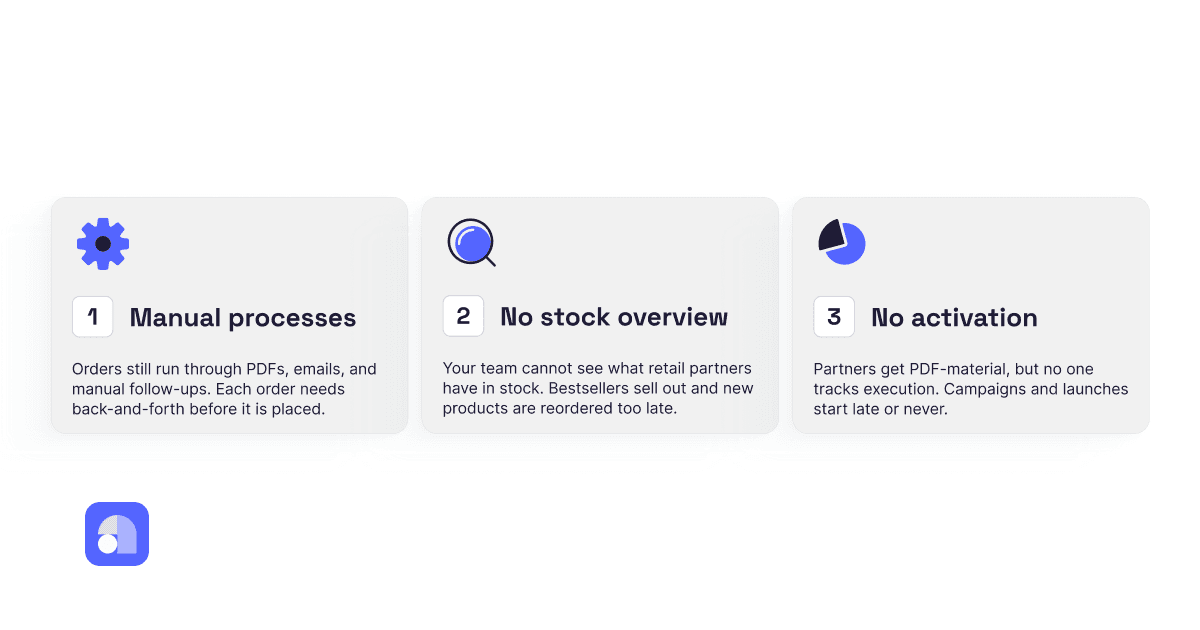
If you spend a day inside a lifestyle brand’s sales department, you see the same pattern. A rep opens CRM to check old notes. Then they jump into ERP to pull yesterday’s stock. Then into spreadsheets to track partner sell-through. Then into email threads to find the latest campaign update. CRM sits at the center of the system, but it doesn’t actually run anything. It can’t.
CRM was designed for companies with customer pipelines. One lead moves through a set of stages until it becomes a paid user. That linear model works fine for a SaaS company in San Francisco.
But wholesale at lifestyle brands is not a pipeline. It is a continuous loop of orders, stock changes, price shifts, launches, seasonality, and reorders across dozens or hundreds of retail partners. CRM was never built for that rhythm, and this mismatch is what creates most of the friction sales teams face today.
Wholesale Is Order-Driven. CRM Is Customer-Driven.
This is the core structural problem.
CRM organizes work around a customer record. Wholesale runs on order flow and partner activity.
Retail partners don’t “progress through stages.” They behave like channels that need constant attention:
• They sell out without notice.
• They reorder at unpredictable times.
• They slow down or spike depending on price and exposure.
• They run campaigns that need activation, reminders, and follow-up.
• They expect fast answers backed by accurate data.
Wholesale is fluid. CRM is linear.
The Specific Ways CRM Fails in Wholesale
CRM shows what happened, not what needs to happen today.
Wholesale requires a live view of partner performance and stock gaps. CRM shows history.
CRM has no understanding of stock or sell-through.
It cannot warn a rep when a partner is about to sell out.
CRM cannot track continuous orders.
There is no way to spot missed reorders or shifting demand across partners.
CRM doesn’t support launch or campaign follow-up.
Campaigns aren’t linear events, yet CRM treats everything like a stage.
CRM makes longtail management impossible.
It offers no structure for staying on top of 50, 100, or 300 partners.
CRM requires manual upkeep with no operational return.
Reps update CRM because they must, not because it helps them move orders.
The result is slow reactions, inconsistent follow-up, and partners that drift.
Why Wholesale Needs an Order-Oriented Operating Model
Wholesale only works well when sales teams have structure around the flow of orders, stock, and partner activity. That means:
• a clear overview of which partners need attention
• early warnings when key SKUs run low on retail sites
• visibility into missed orders
• predictable follow-up for campaigns
• stable weekly routines for the longtail
• one workflow that matches how partners actually behave
Wholesale doesn’t need another contact database.
It needs a real operating system.
What Happens When Sales Teams Stop Forcing CRM Into the Wrong Job
The shift is immediate.
Reorders happen earlier.
Because stock gaps are caught before they become lost sales.
Campaigns run on time.
Because follow-up becomes a routine, not a guess.
Longtail partners grow.
They get steady attention instead of reactive coverage.
Reps recover time.
They stop gathering data and start having real conversations.
Forecasts improve.
Because the underlying execution becomes more stable.
The gains don’t come from working harder.
They come from working inside a structure built for wholesale, not for SaaS.
Where Wholesale Is Moving Next
ERP and CRM aren’t going anywhere. They play important roles. But neither can run the daily execution that drives sell-in. Online and omni retailers expect clarity, speed, and consistency. Sales teams need a workflow that supports these expectations, not a pipeline tool stretched far beyond its design.
The brands that adopt order-oriented systems first will operate faster, catch opportunities earlier, and build stronger partnerships. Those that continue forcing CRM into the role of wholesale engine will feel the gap widen.
Wholesale is not a pipeline. It is a system of ongoing signals and actions. And the teams that structure around that truth will set the pace.
Want the full picture?
Read our complete guide to wholesale execution for lifestyle brands. A practical breakdown of how modern brands run wholesale without spreadsheets, guesswork, or constant follow-ups.

Casper Brix
Co-founder
Casper Brix is the co-founder of Atlo. He draws on 7 years as Chief Purchasing Officer and commercial leadership, now helping lifestyle brands improve how they manage retail partners and grow their wholesale.
Ready to stop losing orders?
Latest posts
Discover other pieces of writing in our blog