Transforming wholesale from reactive to proactive
A beauty brand waited for partners to order. We helped it build partner-specific order proposals around the key products that must always be in stock with its online key partners. Stock coverage on those products rose 41%, and the brand now proposes rather than waits.
Three outcomes that defined the shift
Outcome 1
+41% stock coverage
On the key products that must always be in stock with online key partners.
Outcome 2
Proposals replaced waiting
Partner-specific orders built from shelf data, sent before the partner asks.
Outcome 3
Key products defined per partner
Each partner has a named list, monitored daily, rather than the full catalogue.
The challenge
The brand’s wholesale channel ran on inbound. A partner ordered when a partner remembered to order, and the account team found out what had sold when the order arrived.
That made the biggest online partners the least predictable. A hero product could be unavailable for weeks at a partner running paid traffic to the category, and the brand would not know. Nobody could say which products were the ones that must never go out of stock, because that list had never been written down.
The approach
We started by naming the key products per partner. Not the full catalogue, but the handful that carry the revenue and must always be available at each online key partner.
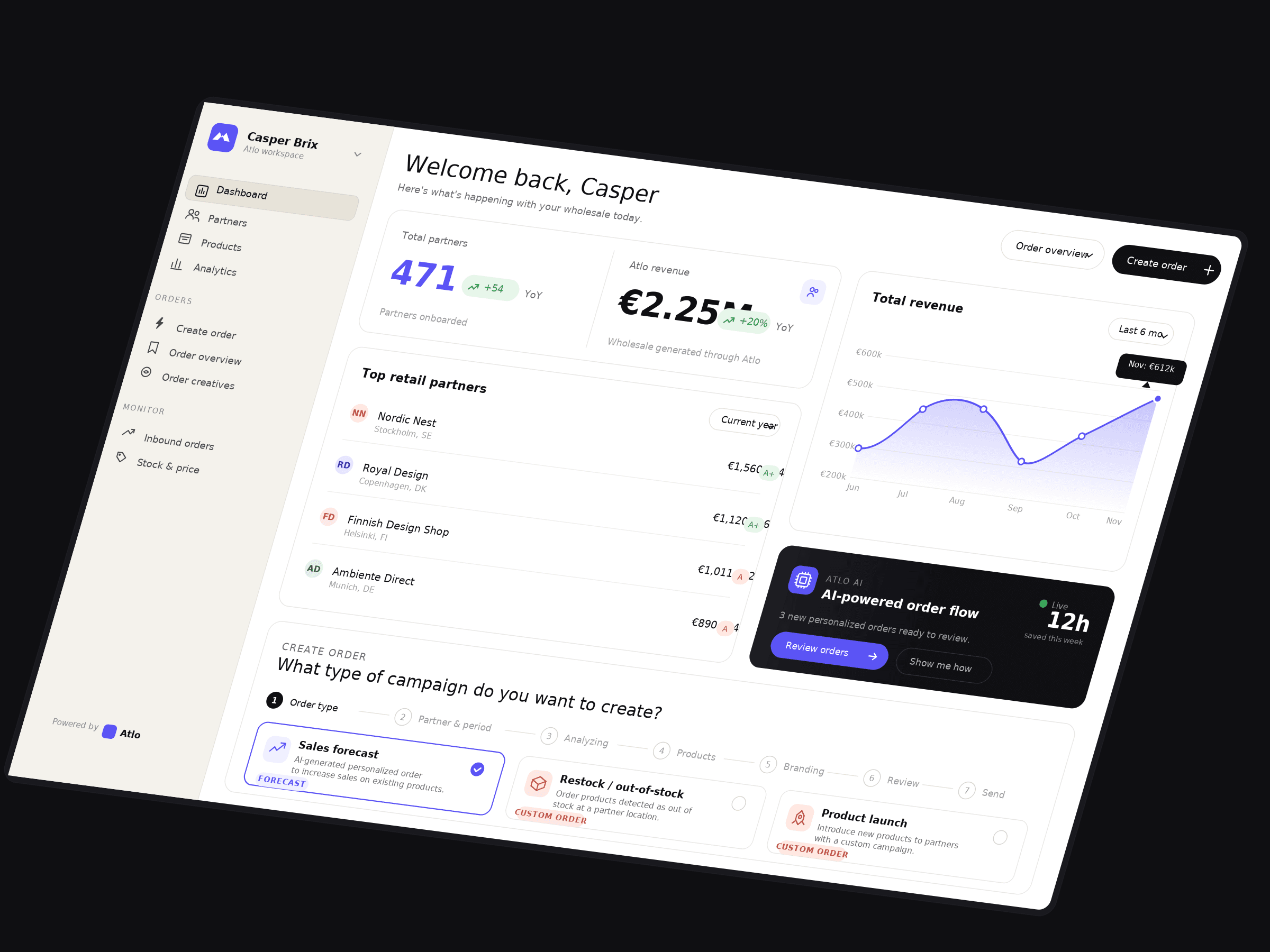
Atlo monitors those products daily. When coverage drops, it builds a partner-specific proposal around exactly those products, priced on that partner’s terms, which the account manager sends as a link.
The proposal arrives while the gap is still a gap, which is the whole difference between proactive and reactive. The partner still decides. They just decide on something concrete rather than on a reminder.
The impact
Stock coverage on the key products rose 41% across the online key partners.
The account team’s week changed shape. Instead of processing what came in, they send proposals built from what the shelves show, and the partners who consistently sell through are now visible enough to prioritise.
We used to find out what sold when the next order came in. Now we send the order before they ask, and it is built from what is actually missing.
Transforming wholesale from reactive to proactive
A beauty brand waited for partners to order. We helped it build partner-specific order proposals around the key products that must always be in stock with its online key partners. Stock coverage on those products rose 41%, and the brand now proposes rather than waits.
Three outcomes that defined the shift
Outcome 1
+41% stock coverage
On the key products that must always be in stock with online key partners.
Outcome 2
Proposals replaced waiting
Partner-specific orders built from shelf data, sent before the partner asks.
Outcome 3
Key products defined per partner
Each partner has a named list, monitored daily, rather than the full catalogue.
The challenge
The brand’s wholesale channel ran on inbound. A partner ordered when a partner remembered to order, and the account team found out what had sold when the order arrived.
That made the biggest online partners the least predictable. A hero product could be unavailable for weeks at a partner running paid traffic to the category, and the brand would not know. Nobody could say which products were the ones that must never go out of stock, because that list had never been written down.
The approach
We started by naming the key products per partner. Not the full catalogue, but the handful that carry the revenue and must always be available at each online key partner.
Atlo monitors those products daily. When coverage drops, it builds a partner-specific proposal around exactly those products, priced on that partner’s terms, which the account manager sends as a link.
The proposal arrives while the gap is still a gap, which is the whole difference between proactive and reactive. The partner still decides. They just decide on something concrete rather than on a reminder.
The impact
Stock coverage on the key products rose 41% across the online key partners.
The account team’s week changed shape. Instead of processing what came in, they send proposals built from what the shelves show, and the partners who consistently sell through are now visible enough to prioritise.
We used to find out what sold when the next order came in. Now we send the order before they ask, and it is built from what is actually missing.
Want to try Atlo?
See how lifestyle brands use Atlo to identify unrealized sales potential and send personalized orders to retail partners.
Book a demo