For brands new to wholesale
New to wholesale. Start with the right partners.
Atlo helps brands decide what wholesale is for, find the right first retailers and avoid the mistakes that stall a new channel.
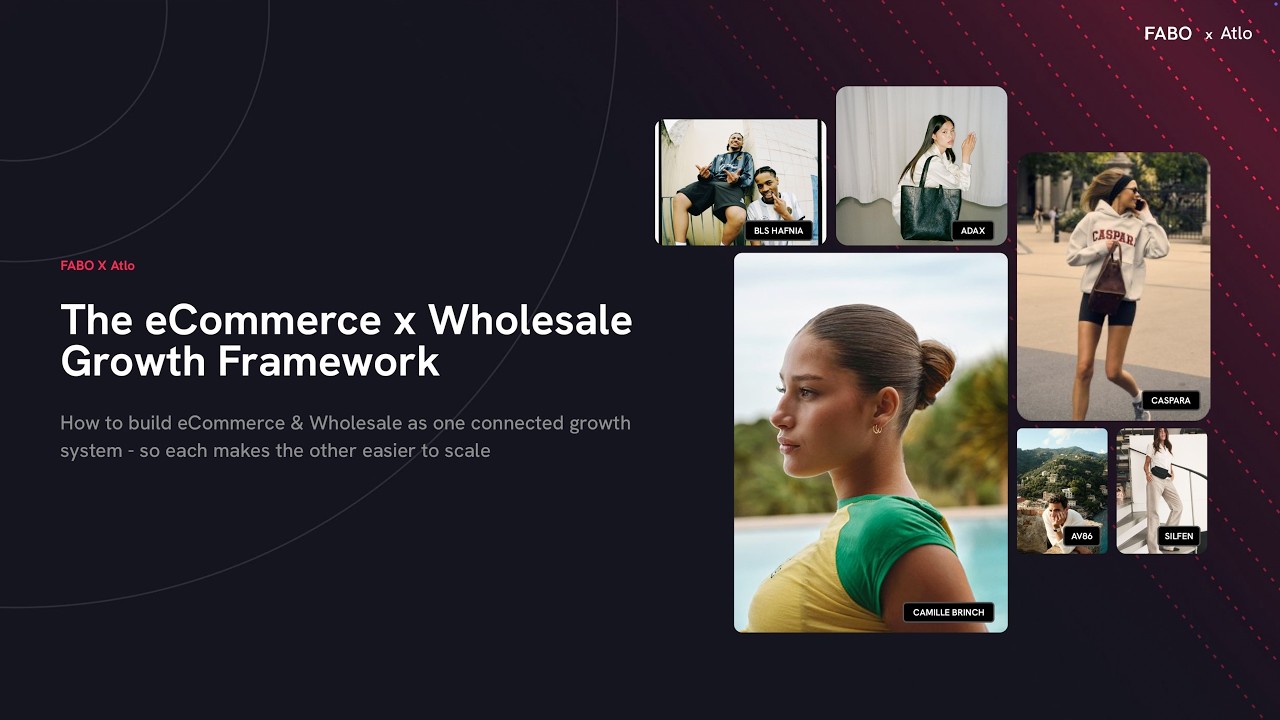
FABO x Atlo · case presentation
How to build eCommerce and wholesale as one connected growth system.
Without and with Atlo
Your first retail network, built on data instead of guesswork.
Common questions
The ones that come up on almost every call. 33 answers from brands that went wholesale.
Scope, partners, getting in the door, marketing activation, operations, pricing, channel conflict and the first 90 days. Built with FABO, a lifestyle marketing agency.
Scope
01 Should we do wholesale at all?
Wholesale gives you two things direct-to-consumer (D2C) does not.
Steadier cash flow, because a partner order is a bigger and more predictable lump than a day of webshop traffic. And presence. A retail network puts your product in front of people in markets you cannot reach on your own, in shops they already trust.
It costs you three things.
Margin, because the partner takes theirs. Control of the final price, permanently. And attention, because a wholesale channel nobody owns internally does nothing.
The mistake is copying your D2C strategy across. It does not transfer. Different buyers, different sales cycle, different content, different payment terms, different definition of a good week.
Without a clear strategy you end up with unactivated partners, dead stock sitting in someone else’s warehouse, and marketing packages you paid for that nobody used.
02 What should wholesale be for: sales, brand, or both?
Pick one as primary.
If it is sales, you can go broader. Marketplaces, large cross-border online players, anyone with volume running through them.
If it is brand, you go narrow. A handful of niche partners where being on the shelf says something about you.
Most brands say both. Both is where it falls apart, because the two goals want different partners and the pitch to each is different.
The specific failure looks like this. A brand says it will not risk the brand and will not risk cannibalising its own sales, but also wants volume. So it hesitates on the big partners and hesitates on the niche ones, nobody internally owns the decision, and a year later there is no channel.
Decide which one wins when the two collide. Then write down the market you are opening and the market you are protecting. They are usually not the same market.
03 What is the risk of starting too early?
Money and attention spent on partners who never activate.
You send stock, you send a marketing package, and nothing happens, because you had no way to tell whether a partner was working out and no plan for what to do about it.
Signs you are too early: your own numbers are not good enough to interest a buyer, you cannot fill a partner order without emptying your own webshop, and nobody on the team has hours in their week for this.
04 Should this be a small test or a real bet?
It has to be real enough that someone owns it.
A test is fine. Ten partners, one type, one market, and a decision point at the end. What does not work is wholesale as everyone’s side project. If it is the thing you get to on Fridays, nothing happens and you learn nothing.
One brand put it plainly: they were happy to run it for six months and pivot if it did not work. That is a good posture. Agile and pragmatic beats a two-year plan, as long as somebody’s name is on it.
Creating a retail network
05 How many retail partners do we need?
Build a list of 50. Start conversations with 10.
Fifty is the research target, not the launch target. You find the names, you check where your competition is stocked, you prepare agreements and an onboarding plan.
Ten is where you actually start, so you learn what partners ask for before you have forty of them asking.
Roughly 80% of sales comes from the biggest 20% of partners. So the first three to five you win matter more than the next thirty. Win those, then use them: “we already have our products listed at X and the numbers are good.”
06 How do we find the 50?
Look at where your competitors are stocked.
Pick your top five comparable brands. Search where they sell. That list has already been filtered by somebody else’s buying team, and it tells you which shops take on brands like yours.
Then work out what is missing. If you want a market you have no presence in, search that market specifically rather than defaulting to the shops you already know.
For international, drop your home market from the search entirely and ask who the best five to ten partners in the rest of the EU are. Danish eyes find Danish shops. That is not the exercise.
07 Should we start with small partners or big ones?
If you can win a big one from the start, do it. Your leverage is highest before you have signed anyone below them, and a big partner finds you more interesting when you are not already in five hundred shops.
If you cannot win them cold, go small, then medium, then large, and use the names you earn on the way. The fear-of-missing-out line works: “we are already listed at X and doing good numbers.”
There is a second argument for going big first. A large partner often takes about the same amount of work to land as a small one. If the effort is the same, take the one that moves volume.
Land one and the rest gets easier. Everybody watches everybody in this industry.
08 Volume partners or brand-building partners?
Most partners will do nothing for your brand unless you ask them to.
If you want brand activity, you have to require it: “if you want to work with our brand, we expect X, Y and Z.” That only works if your own brand is strong on your own touchpoints first. Website, social, content. If it is not, you have no leverage to ask.
Be honest about the trade. If you go purely physical and purely niche for brand reasons, expect very little revenue. Ten very solid partners can build brand for you and still not move your P&L. That can be exactly right. It is wrong if you need revenue in eighteen months.
09 Physical or online?
You need both, weighted by your goal.
Almost every partner is omni-channel now, but one channel is always stronger for them. Find out which before you pitch.
Physical partners catch the customer who wants to see and touch the product. That matters more for some categories than others. If your product is something people hesitate to buy without trying, physical presence opens a customer group your webshop cannot reach at all.
Online partners drive sales faster, and they build brand too. The large online players do not think in countries. They run Europe. Pitch them as a European partner, not as a Dutch one.
A pattern worth stealing: physical at home, online abroad. Physical retail in your home market where brand matters and you already have presence. Large cross-border online partners in the markets you are trying to enter, because they move volume and give you data fast.
10 Should we mix partner types?
Not in the first round.
Retailers and, say, salons or hotels are two different businesses. Different price lists, different order sizes, different service levels, different systems to manage them.
Pick one type. Get ten of them working. Then add the second type as a deliberate second step.
It helps to separate them in your head. Retailers and online marketplaces are wholesale. Salons, hotels, gift and corporate partners are closer to contract sales. Agents and distributors are a third thing again. Mixing all three at once is how a two-person team ends up doing none of them well.
11 Which market should we start in?
Usually not the one you are strongest in.
If your domestic market is already working through your own channels, opening ten domestic retailers mostly moves revenue you already had, at a lower margin. Protect the market where your D2C is strong. Use wholesale to open the markets you cannot reach alone.
A useful sequence: run broad D2C advertising in the target market first and see how it responds. Where there is traction, bring in a partner. You pitch a market you can already prove, and you know what a partner is worth there before you negotiate.
Getting in the door
12 How do we find the right person to contact?
Not through the contact form. Most large retailers do not publish a B2B contact, and customer service will not pass you through.
Go to LinkedIn and find the buyer, category manager or marketplace manager. Reach out on the channel where you are strongest. If Instagram is your strength, use Instagram alongside LinkedIn and email.
If you cannot work out who it is, ask. A message that says “we are working out who the right partners are for us, who should I be speaking to?” gets answered more often than a pitch does.
It takes attempts. That is normal, and it is not personal.
13 What should the first message say?
Do not ask to be let in.
The wrong version is “please consider stocking us, here is our PDF.” The right version is a case: we are growing, here is the proof, we are selecting partners, why should it be you.
Something close to this has worked:
“We are growing fast and we are working out who the right partners are for us in Europe. We have sold X of this product, we are strong in these markets, we can see this demand pattern where you operate. We think that translates to roughly this much for you. Who should I be speaking with?”
Five things belong in it. What you sell and who buys it. One number that is hard to ignore. Why them specifically. What you are proposing. A clear next step.
You have more to work with than you think. Your webshop knows exactly who your customers are, where they are, what converts and what they say about it. Most brands never put any of that in front of a buyer. One brand came to a call with twenty thousand customers, a 4.3 rating and an award nomination, none of which a buyer had ever seen.
That data is worth real money to a buyer, because it de-risks their decision.
14 What do partners actually ask for?
Three things, almost always, and almost always in this order.
What is the discount. What are the freight terms. What are the payment terms.
Everything else comes after they are interested. So do not spend two weeks building a full partner pack before you have a reply. Get the pitch out, get the conversation, then prepare the detail.
Marketing activation
15 What marketing support can we expect from a partner?
Free onboarding marketing. The “welcome to brand X” post. That is standard and you should ask for it.
Beyond that, large partners charge. They will offer you an incentive programme: you pay, they promote. Unless your brand position is unusually strong, that is the deal.
16 How do we win activation if we have a budget?
Pay for it, and make sure it is profitable.
Price the individual placements so you can negotiate against them. A front page banner is worth roughly €2,000. An Instagram post roughly €1,000. Once you have those numbers you are negotiating about value, not about goodwill.
17 How do we win marketing activation without a budget?
Two options. One of them is better.
Putting it in the contract. This backfires with large partners early on, because you have no leverage yet. And without a system to check, you do not know whether they actually did it.
A kickback tied to an order. This is the one to use. Build a specific order proposal and offer 5 to 10% off it in exchange for agreed marketing.
The maths is easy to show. If your wholesale price is 45% of RRP, multiply by 1.1 and you are at 49.5% of RRP. On a €100,000 order that is €10,000 of marketing value, funded by the order itself.
Then reverse engineer it. Price the placements so you can negotiate against them. A front page banner is worth roughly €2,000, an Instagram post roughly €1,000. Once you have those numbers you know exactly what €10,000 should buy, and you can say so.
One thing to be careful about. A rebate tied to marketing the partner actually delivers is a commercial agreement. A rebate whose size depends on what the partner charges is resale price maintenance, and it has been fined in Denmark. Tie the money to the banner, the post and the campaign. Never to the price.
Operational
18 What do we need in place before we can sell wholesale?
- Product master data. Product ID, item numbers, EAN or GTIN per variant.
- Price lists in local currency.
- Content, ideally in an image bank the partner can pull from: product images, lifestyle images, and video. Video is the one that moves the needle, because it lifts conversion on the partner’s site and almost no brand supplies it.
- Packaging dimensions, weights, carton and pallet data.
- Minimum order quantity and minimum order value.
- Delivery terms and lead times.
- A B2B return and complaint process, separate from your consumer policy.
- Compliance for your category: CE, EU declaration of conformity, manuals, safety instructions, WEEE, packaging responsibility, product liability insurance, HS codes, country of origin.
Norway, Sweden and Germany each add requirements. Sort the must-haves from the later-haves before outreach.
Make it easy for the partner to sell you. Every piece of friction is a reason to push your products down the list.
19 How much stock should a partner hold?
As a rule of thumb, require a minimum of around €10,000 from a new partner.
It varies a lot by category. Interior brands in particular will rarely get a partner to take the full assortment, and that is fine. What matters is that they commit. Stock and marketing, not a token order.
A partner with three products on the shelf is not a partner. They are a listing.
Watch two things at once. Normal stock and consignment behave completely differently on your balance sheet. And you now forecast for two channels out of one inventory, so decide in advance who gets the last hundred units when your own webshop and a partner both want them.
20 What is the difference between wholesale, marketplace, consignment, dropshipping, agent and distributor?
Three boxes.
Wholesale. Classic. They buy from you, they own the stock, they sell it. Marketplaces mostly behave the same way. This is where you start.
Partner models. Consignment and affiliate. You keep the risk, they keep the shelf.
Intermediaries. Agents and distributors. Someone else opens the door or holds the stock.
Dropshipping in B2B, where you ship from your own 3PL on the partner’s order, exists but is not standard practice yet. Most large partners do not have the technical setup for it. It will come.
21 Should we use consignment?
Only with your eyes open.
Consignment usually shows up with the big department-store type partners. You ship product to their warehouse and you get paid only for what sells.
Their terms can be aggressive. Read them properly and get someone experienced to look at them before you sign.
The thing that catches brands out is liquidity, not the commercial terms. Coming from D2C you are used to having the money more or less immediately. Consignment means you have paid for goods sitting in someone else’s building, generating nothing, for as long as it takes.
If you do it, agree in writing what marketing they commit to and what service standards apply. You get a lot less say once the stock is in their warehouse.
22 Should we use an agent or a distributor?
An agent sits between you and the retailer. They already know the buyer at the shops you want. That is worth real money.
They usually cost nothing but a percentage of what they bring, so there is no salary risk. The catch is that they carry twenty other brands and none of them is yours. They are paid to move product, not to build your brand.
Finding the right one is the entire difference. Ask your network, post publicly, work out who knows whom. A bad agent costs you a year.
A distributor does the same but also carries stock. That fits markets where you cannot ship from a European warehouse to an end customer: the US, Australia, Japan. They take the local headaches and they take more control.
Inside the EU you usually do not need one. If your 3PL ships cross-border, an agent is the better fit.
Most brands run an external or hybrid sales setup at the start, then bring it in-house as they grow. In-house is more expensive than a percentage of sales, so do it when the volume justifies it.
23 What about Amazon?
It works for some brands. It is closer to running another e-commerce channel than to wholesale, and it is a discipline of its own.
You keep more control over price than you do with a retail partner, which is a real advantage. But it needs dedicated attention, and if nobody on the team knows the platform it is a project, not a quick win.
Treat it as a separate decision from your wholesale strategy, not as part of it.
Pricing and money
24 How do we set our wholesale price?
Two ways to structure it.
Recommended retail price excluding VAT, minus a discount. A product at DKK 1,000 including VAT is DKK 800 excluding VAT in Denmark. At 50% discount the wholesale price is DKK 400.
Or a direct wholesale price per product. This one costs DKK 400, that one costs DKK 300.
Either works. What matters is that you calculate it bottom-up rather than starting from a percentage you heard somewhere.
Cost price. Plus logistics. Plus a buffer for customer service, handling and returns. That is your floor. Then work out what discount is possible above it.
Some brands set the whole thing in motion and discover they make almost nothing from day one. At that point the volume is irrelevant.
25 Should we price by product or by category?
Category. Lamps, furniture, accessories.
It is easier to administer, easier to defend in a negotiation, and it stops the conversation turning into line-by-line haggling. Product-level pricing stops being manageable as soon as you have more than a handful of partners.
Decide your volume tiers at the same time. Retrofitting a discount ladder onto existing partners is a painful conversation.
26 Who sets the retail price once we sell through partners?
They do.
As a 100% D2C brand you set the price to the consumer. The moment a retail partner buys from you, the resale price is theirs to set. That is not an industry norm, it is EU competition law, and it is enforced.
What you can do:
- Publish a recommended retail price. Recommending is lawful.
- Set a maximum resale price. Also lawful.
- Decide who you supply in the first place, on objective criteria you apply consistently, such as service level, positioning, market and category fit.
- Agree commercial terms that are not price: stock commitments, marketing commitments, assortment, territory, channel, service standards.
- Differentiate your assortment, so your own shop and your partners are not always selling the identical item.
What you cannot do:
- Set a minimum resale price, or a minimum advertised price.
- Make a recommended price function as a minimum, whether by agreement or by understanding.
- Use pressure. Threatening to cut supply, delay delivery or withdraw support because of a partner’s pricing.
- Use incentives. Making a discount, rebate, marketing contribution or bonus depend on the partner’s resale price.
- Ask a partner to confirm they will hold a price. The moment they agree, you have an agreement, and that is the thing the law prohibits.
What this costs in practice. A partner runs minus 30% on your products in November. It undercuts your own campaign and moves sales from your webshop into wholesale at a lower margin. You will see it happen. You cannot act on it.
The only real lever is the one you use before you sign: who you choose to supply, and why. Once the product is theirs, the price is theirs.
How seriously this is taken. In Denmark it is enforced criminally. A Danish design brand was fined DKK 6,000,000 in 2020 for requiring resellers to treat its recommended prices as minimum prices. In a separate case, the Danish arm of an electronics manufacturer accepted a DKK 3,600,000 fine for a kickback scheme where the retailer’s margin depended on holding minimum prices.
At EU level, the Commission fined four consumer electronics manufacturers a combined €111 million in July 2018 for imposing fixed or minimum resale prices on online retailers.
Monitoring what your partners charge is lawful and normal. Acting on it to constrain what they charge is not.
This is a general description of how the rules have been applied. It is not legal advice. Have your distribution agreements and your partner communications reviewed by a competition lawyer.
27 How does wholesale change our cash flow?
This is where most brands get hurt, and it is not the part they worry about.
In D2C the money arrives before or as the product ships. In wholesale it arrives 30 to 60 days after.
A partner orders for half a million. You put production in motion, pay the factory, pay the freight, pay the warehouse. Terms are net 30. Larger partners will push for 60 and they will not think of it as aggressive.
For that period you are effectively financing their business.
Decide before the negotiation what terms you can carry, and say no calmly when someone asks for more. Add consignment on top and the exposure grows again, because now you are also holding stock you have paid for in someone else’s warehouse.
Run the numbers before you sign anything: revenue per partner type, contribution margin after discount, freight, returns and campaign support, cost to acquire a partner including samples and travel, payback period, and capital tied up in stock.
Channel conflict
28 Will wholesale cannibalise our own webshop?
It can, in three ways.
A partner discounts and your customer buys there instead. Same sale, roughly half the margin.
Your paid campaigns send traffic that converts on the partner’s site. You paid for the click, they booked the revenue.
You and your partner bid on the same search terms and your own cost per click goes up.
Segmenting by market is the cleanest defence. Protect the market where your D2C is strong. Use wholesale where you have no presence.
Where you sell in the same market, be selective about who gets the product in the first place.
Expect the split to settle somewhere between 30/70 and 50/50 between the two channels. That is normal, and it changes how you plan.
29 Should we hold products back from wholesale?
If you have a wide assortment, yes, it is worth considering. Exclusive variants, bundles or colours for your own shop reduce the head-to-head overlap.
If you have five products, it is not a real option and you should not pretend otherwise. In that case your protection is partner selection, not assortment design.
30 How do we measure whether wholesale is actually working?
Not by total revenue. Total revenue hides the thing you want to know.
Track incremental revenue by market. New customers by country. And sell-through rather than sell-in. Sell-in tells you what you shipped. Sell-through tells you whether it sold.
Early on, also track the pipeline: replies, meetings, sample-to-order rate, first order size, and reorder rate. Reorder rate is the honest one. A partner who orders once was a transaction. A partner who reorders is a channel.
Ownership and systems
31 Who should own wholesale internally?
Someone, by name.
The most common way this fails is that everyone agrees it is important and nobody has hours in their week for it.
Do not start by hiring an expensive senior wholesale person. Do the first outreach yourself. You will learn what partners actually require, what they ask for, and where your setup falls short. Then hire, once there are roughly twenty partners to manage and you know what you are hiring for.
Hiring first and learning second is how brands end up with a costly person and no channel.
32 When do we need a system for this?
Around 20 to 30 partners.
Below that, a spreadsheet and a shared inbox are fine.
Above it, three things break at once. Nobody knows which of your products a partner actually has listed. Nobody knows what is in stock at any of them. And someone on your team is spending a large part of their week opening partner websites by hand to find out.
That is the point where the channel stops growing because of admin rather than because of demand.
33 What does the first 90 days look like?
Roughly this.
Weeks 1 to 2. Decide the primary goal, the market you are opening, the market you are protecting, and who owns it. Build the list of 50.
Weeks 3 to 4. Get the operational basics in place. Master data, price list, content, terms.
Weeks 5 to 8. Outreach to the first 10. Expect it to be slow and expect silence. Follow up.
Weeks 9 to 12. First agreements, first orders, first onboarding. Write down what each partner asked for that you did not have ready.
At the end you should be able to answer one question: is this a channel or was it a distraction. If it is a channel, that is when you decide on people and systems.
Retailers set their own resale prices. Atlo shows prices as retailers publish them, for your own pricing, campaign and partner planning, never to influence what a retailer charges.
Atlo also helps businesses who are new to wholesale.
Talk to a founder